
Clayton County Wanted List Status
Clayton County does not run a verified most-wanted page. The Clayton County Sheriff’s Office site has no such section, and no county warrant-search portal exists either. So there is no honest way to report a list count, a photo policy, or an update schedule. That absence proves nothing, though. Active warrants can sit quietly inside court and law-enforcement systems without ever reaching a public list.
One local option does exist. A Mar-Mac Police page called Clayton County’s Most Wanted lists people who may have active warrants, with data supplied by law enforcement. The page itself warns that entries can change and that accuracy is not guaranteed. No update cadence is published. Read it as a possible local lead, nothing more, and confirm anything you find there directly with the responsible agency before acting on it.
Clayton Wanted Listing Fields
Treat the Mar-Mac listing with a skeptical eye. Nobody has established how current it is. A field on the page may help you recognize a person, but it cannot tell you whether a warrant is still active. The page carries its own warning, and that warning should govern how you read every entry.
| Field | What it can tell you |
|---|---|
| Name | The identity law enforcement associated with the possibly active warrant. Confirm spelling and identity. |
| Photograph | A visual aid on the source page, not proof that the person committed an offense. Photos are not rehosted here. |
| Warrant or charge | The stated basis for seeking the person, subject to change, service, recall, and court action. |
| Agency context | The local source or law-enforcement connection behind the item. It does not replace direct confirmation. |
| Warning language | The page’s notice that the information may be inaccurate or outdated and that innocence is presumed. |
No verified sheriff source sets a standard format for Clayton County wanted entries. Physical descriptions, caution flags, last-known addresses, and publication dates appear inconsistently at best. Don't fill gaps by guessing from a photo, and don't repeat an address pulled from an old copy of the page. Its real value is recognition. The court and the responsible agency decide actual status.
Use Clayton Fugitive Listings Safely
Start with the source, not the face. Check when a listing was posted. Check who posted it. Clayton County's only local page warns about stale data itself. The Sheriff publishes no verified current list. Those two facts together keep a tentative lead from being mistaken for an official notice about a person today.
- Open the Mar-Mac page and read its full disclaimer before reviewing any item.
- Compare the full name and agency context. Do not identify someone from appearance alone.
- Assume the status may have changed. Do not share the listing as a current fact.
- If the person may pose a danger, submit the information through the Sheriff’s tip form or line. Use 911 for an emergency.
- For a warrant that may affect you, stop at verification. Contact an attorney and the issuing court for a safe resolution path.
An arrest can produce a Clayton County Jail booking record later on. The Sheriff offers no public current-inmate roster. So custody questions need another route. The Clayton County booking-record guide lays out the official request process and the notification options. Remember that a court docket, a jail record, and a wanted-page entry serve different purposes. Each one updates on its own schedule.
Check Clayton County Warrants
Clayton County has no public warrant portal. You cannot just type in a name. If a warrant might affect you personally, go through the issuing court and talk to an attorney. Iowa Courts Online shows a Clayton County criminal case once it becomes public, but it is not a full warrant index. Iowa keeps a criminal case confidential while an arrest or search warrant is outstanding, until that warrant is served. A blank search result clears no one.
- Identify the likely issuing court or case number from paperwork, if available.
- Search Iowa Courts Online by name and narrow the results to Clayton County. Exact spelling matters, and the official search accepts a percent sign as a wildcard.
- Open the Case ID when a public match appears and review the docket. Some advanced material requires a subscription, while fuller access may be available at a clerk public terminal.
- Ask the clerk or an attorney how to verify and address the specific matter. Do not rely on an absent web result.
- Use Sheriff administration for process questions when the issuing source is unclear. Do not visit a location in an attempt to avoid or test service.
The Sheriff publishes no dedicated warrants-unit line. For administration, call 563-245-2422 and choose option 2 during weekday office hours. Option 1 reaches dispatch. Staff can walk you through procedure, but the court record and the issuing authority control a warrant's legal standing. No website can tell you a warrant is active, recalled, or safe to resolve without case-specific advice.
Keep the records straight. A police contact or wanted notice may come first. Then an arrest leads to a Clayton County Jail intake, and the court file takes over from there. Someone released from jail can still have an open case. An old article can show a warrant that was served long ago. A sentenced person may surface later in the Iowa Department of Corrections offender search, which tracks state correctional status rather than current jail custody in Clayton County. Each source is accurate in its own lane, but mixing them produces false answers.
Clayton Warrant Record Types
The word warrant covers several different judicial orders. Clayton County does not publish its own taxonomy of these record types. The distinctions here simply help you route a question to the right place. When the answer matters, read the actual court document and get legal advice.
| Record type | Why the route differs |
|---|---|
| Arrest warrant | Authorizes an arrest in connection with an alleged offense. An outstanding case may remain confidential until service. |
| Search warrant | Authorizes a defined search. Related criminal material can also be restricted while the warrant remains outstanding. |
| Court nonappearance order | May arise after a missed required court event. The case docket and clerk are key verification sources. |
| Possibly active local listing | A public-facing lead such as the Mar-Mac page. It still requires current agency or court confirmation. |
A wanted page is selective by design. Most warrants never appear on one. A person can also stay listed after the facts change if nobody revises the page. Flip it around, and a court name search can miss a live matter because access stays restricted until service. Those limits are exactly why a direct, case-specific check beats any public list.
Clayton Fugitive Tip Channels
Two local tip routes matter in Clayton County. The Sheriff takes information through a confidential web form and an anonymous phone line. Guttenberg runs its own city crime-tip number. Neither offers a reward, so don't call either one a Crime Stoppers payout program.
Clayton County Sheriff’s Office
Anonymous tip line: 563-245-1234
Tip form: Submit a Sheriff tip
Emergency: 911
Administration: 563-245-2422 option 2
Speed matters when a tip involves danger. The Sheriff's online form allows a blank name field and keeps submissions confidential. But nobody watches it around the clock, so it is the wrong channel for an immediate threat. Guttenberg residents have a city crime-tip line at 563-252-3987 for nonemergency leads. If help is needed right away, call 911.
The screenshot below shows the working Sheriff tip route, with no wanted person or booking photo displayed. The official Clayton County tip page carries the current instructions from the office itself.
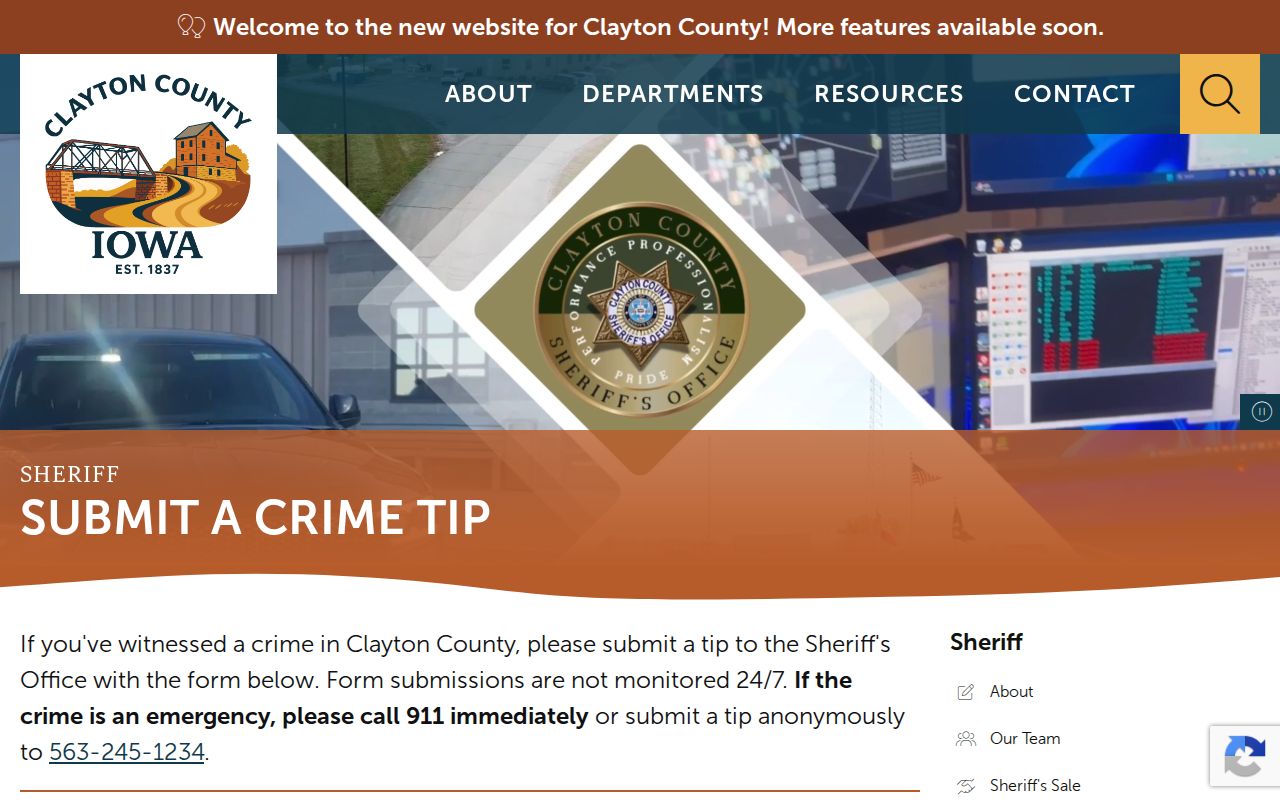
That page exists for one purpose: passing facts to the Sheriff. It confirms the local contact method and its limits. Treat it as a one-way channel for information, not a place to seek a public reply or confront anyone.
Clayton Warrant Alerts Are Limited
Clayton County has no verified Sheriff social account that posts bookings, runs a "Warrant Wednesday" feature, or maintains a wanted-fugitive series. Watch for confusion with sheriff accounts in Clayton County, Georgia. Before sharing any post, confirm both the Iowa location and the agency behind it.
IowaVINE handles notifications tied to custody and criminal cases for people held in Iowa county jails or supervised by the Iowa Department of Corrections. It can alert subscribers to a release, escape, or death. What it will not do is promise mugshots or a warrant list. Alert Iowa and Smart911 send emergency, weather, and community notices. No official Clayton County inmate-search app exists.
The Sheriff connects to IowaVINE through its Victim Information page. The service also answers by phone at 1-888-742-8463. Registration is automated and anonymous. It works well for tracking a defined custody change, though signing up does not verify an outstanding warrant. Formal victim registration with the Iowa DOC or Board of Parole is a separate process. Save Alert Iowa enrollment for county emergency and community notices rather than tracking a named person.
Public Record Search
Sponsored Results